

Can trauma cause ADHD in adults?
If you’re wondering can trauma cause ADHD in adults, I hope this blog will help you to understand how ADHD and trauma are different. One is the result of nurture, and is an adaptive responses to the environment. The other, is largely (60-90% in some studies) biologically determined, and present from birth.
We will look at how ADHD and trauma symptoms can be confused with each other, and compare the ADHD and trauma symptoms that are most easily muddled up. So that you can differentiate between what is trauma related, and therefore transmutable (through inner work or therapy), and what belongs to your diversity, which may require lifelong management and adjustments, which can make a huge difference.
Developmental trauma and ADHD in adults
I have seen in my clinical work how distressing it can be for patients, when there is lack of clarity and understanding about why they are the way they are. When traits due to your ADHD are misinterpreted as deficits that you should be able to change. For e.g., if you always thought your lack of focus was due to a lack of will power or laziness, it can be life changing to understand your brain is wired differently, and it’s not your fault. Learning this can help build self-compassion, however it can also trigger grief about not having known this earlier.
More often than not, developmental trauma (C-PTSD) presents alongside neurodiversity.
NHS England estimates that ADHD is under-recognised, underdiagnosed, and undertreated, with a population of 3–5%. This lack of education means many individuals struggle on, alone, resulting in experiences of feeling misunderstood, different, and lonely. With a constant sense of failure for never getting it right- according to parents, siblings, friends, teachers, and a world that is predominantly neurotypical, and that operates under neurotypical constructs.
The good news is, when you’re able to separate what belongs to your trauma, and what belongs to your neurodiversity, you can stop blaming yourself for things that cannot be changed, and start the healing journey of processing your trauma. Alongside this, equipping yourself with support and strategies for your ADHD, may significantly improve your life. Many people with ADHD thrive with the right support.

Why ADHD is not trauma
Advanced brain imaging research (fMRI and structural MRI) suggests that ADHD is predominantly determined by genetics, and concerns functional, structural, and chemical changes in the brain that operate differently to those of a neurotypical brain. It’s a distinct neurodevelopmental way of experiencing and organising the world.
Brain scans have shown similarities in the brains of ADHD family members that are significantly different to the neurotypical brain, and it’s a lifelong condition. Although the aetiology of ADHD is still not 100% known, and may depend on multiple intertwining factors, at present it would seem that there is no amount of therapy, love, or trauma that can either cause or eradicate ADHD. However, you may find that as your trauma is worked through, you can better manage your ADHD.
Why trauma is not ADHD
Trauma is an adaptation to our early and ongoing environment. It’s how we responded to abuse, neglect, or an accumulation of misattunement or criticism from our parents or main carers. It’s the result of feeling alone and unsafe, with no escape, and overwhelmed with this often repeated experience. As we live in a neurotypical world, the misattunement that neurodiverse children often experience can accumulate into painful relational ruptures that cannot always be repaired. Read more on trauma in my blog here.
ADHD Vs Trauma symptoms
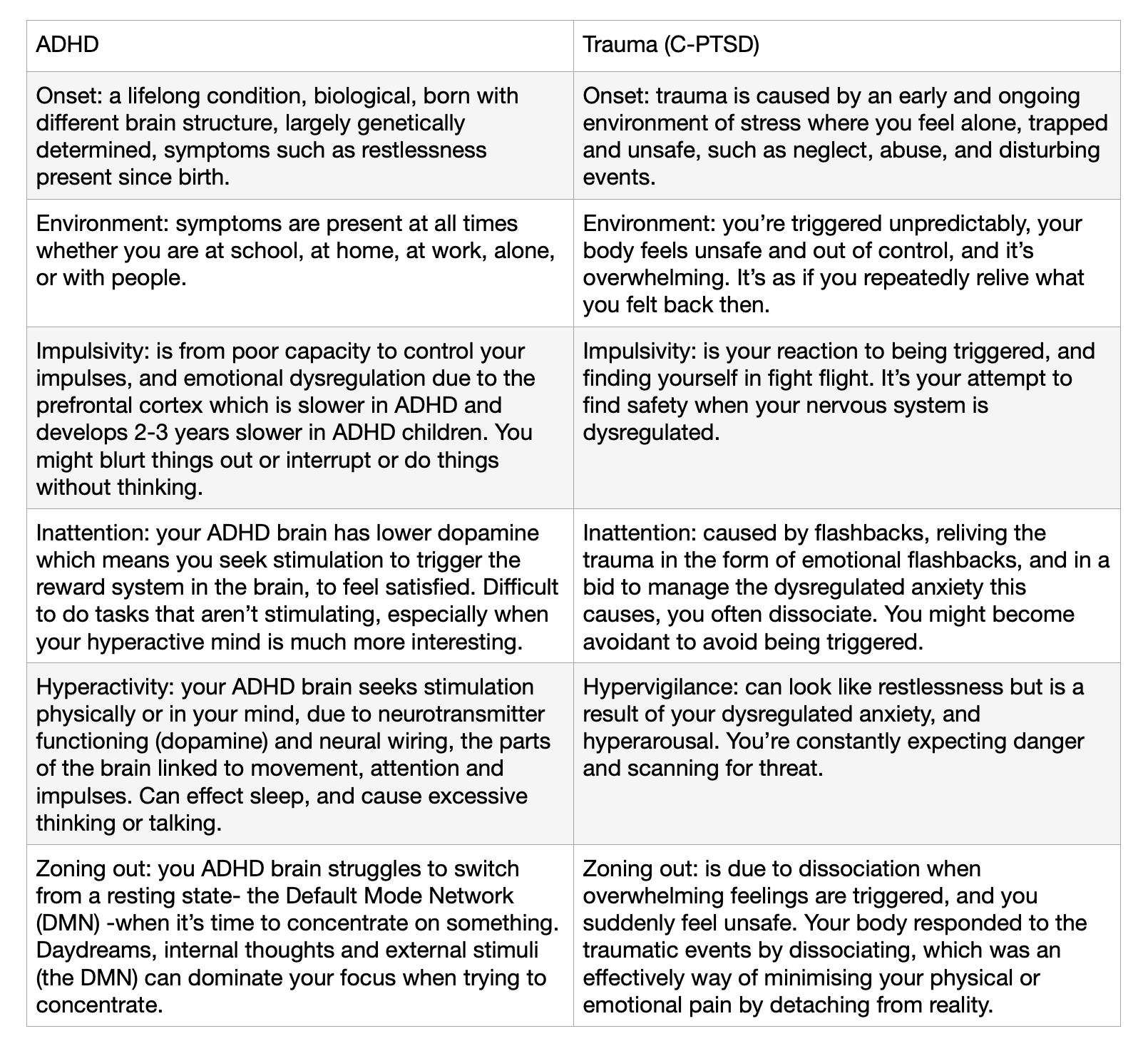
Here is a table of the most common traits in both ADHD and trauma that can be misread or confused. These symptoms may seem the same from the outside looking in, but as you can see, are significantly different:
Conclusion
In this blog we’ve been thinking about the question, can trauma cause ADHD in adults? We’ve looked at how these two conditions often present together, and why this may be. To clarify the difference, I’ve outlined what ADHD is, and what trauma is, and then compared some of the symptoms that often get muddled up between the two, with details of what each symptom embodies for both ADHD and trauma.
If you can relate, would you like some help?
If you’d like professional help then I’d be happy to hear from you. Contact me here and we can arrange a free, 15-minute telephone consultation to think about how I can support you.